Showing posts with label Charite artificial disc. Show all posts

Monday, December 3, 2007

Spine surgery and all of the new "devices"
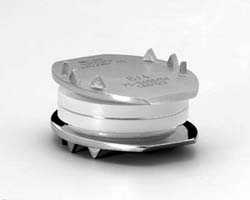

Every MONTH it seems like another new DEVICE OR PROCEDURE for Spine Surgery is approved. There are new and less invasive ways to fuse different levels of the spine, especially the lumbar and cervical discs. There are new tools, devices and procedures. The only problem is after all the surgery and the pain of fusions most patients are no better off and in most cases worse than before. How do I know? I have been there done that, I have researched it for 20 years and I receive comments and e-mails of people just like me, a living mass of pain.

Since I believe that man was created by a higher power, if he had meant for the spine to be rigid, he would have made it that way.

Now enter the Charite' artificial disc which was first developed in Berlin, Germany almost 20 years ago with dismal results. Depuy Industries owned by Johnson and Johnson purchased the company that owned the disc and of course got it pushed through the FDA with a short clinical trial, spine surgeons started implanting the device in the USA, in the L4-L5 area of back patients.
____________________________________________________________
"Seven months later, on May 13, 2005, the Street.com, reported that Dr Charles Rosen, an associate clinical professor of spine surgery at the University of California at Irvine, was calling for an immediate recall of the Charite, pointing out fundamental flaws in J&J's study design.

He told the Street that J&J compared the Charite to BAK cages in spinal fusions, a failed procedure that had not been performed in years. According to Dr Rosen, the comparison is "the worst possible operation to compare these things to."

J&J responded by saying the BAK was the standard treatment for degenerative disc disease at the time of the study.

According to the Street, Dr Rosen said J&J ignored the first patients who underwent the surgery, and that exclusion of such a significant portion of the sample size can seriously compromise the quality of statistical data.

Dr Rosen, who is also the founder of the UCI Spine Center, told the Orange County Register on April 12, 2006, that the Charite can cause more pain than it cures.

Forty-five year old, Dane Titsworth, from a hospital bed at UCI Medical Center, recovering from his fourth back surgery, told the Register, that the pain he experienced with the Charite he had implanted in May 2005, was like driving a big rig over your legs.

After the Charite surgery, Mr Titsworth said the pain became unbearable and cost him his job with State Farm Insurance, and nearly his marriage.

Dr Rosen fused the part of his spine where another surgeon had implanted the disc.

The Charite does not absorb shock like a healthy disc or mimic natural motion, Dr Rosen told USA Today on July 25, 2006, and a dislocation or fracture of the disc can also cause problems, he said.

In March 2006, Dr Rosen says, eight more patients like Mr Titsworth contacted him, who have more pain in their back with the Charite than without it.

In May 2006, Medicare decided to stop paying for the device in patients over 60, noting that the $30,000 to $50,000 surgery had not been sufficiently tested for long-term affects.

Blue Cross and Blue Shield also determined that more research was needed over a longer period of time, although insurance plans in each state determine coverage decisions individually, according to USA Today.

On October 20, 2005, the Bagolie Friedman law firm announced the formation of the "International Charite Artificial Disc Practice Group," based on a belief that numerous people in the US and abroad, "suffer Charite artificial disc failure," and that "Johnson and Johnson is responsible for manufacturing a medical device they knew or should have known was unreasonably dangerous in an attempt to capture some of the lucrative multi billion dollar back surgery market."

"We will be reviewing potential cases from the United States, Australia and Europe," said Mr Bagolie.

On June 5, 2006, the Street.com reported that Chicago-based attorney, Pete Flowers, has more than 200 clients who have complications from the Charite and who are seeking reparations from DePuy Spine.

Twenty-eight lawsuits have been filed, Mr Flowers told the Street, and he expects an additional 40 to 50 more to be filed this month. Dane Titsworth is a client of the firm.

Mr Flowers' clients claim the Charite is defective and that J&J improperly marketed the device and did not adequately warn of the disc's dangers.

"Most of these people are between 25 and 45 years old," he told the Street.com. "A lot of them have lost their jobs, their spouses, their families, their houses -- everything."

Since the disc was approved in the US, more than 5,000 people have received the implant, says DePuy Spine's Bill Christianson, vice president of regulatory affairs, according to USA Today on July 25, 2006."

Lawsuits Multiply

Thursday, August 9, 2007

But it is FDA approved!!


SO WHAT!! Who do you think sits on the advisory boards that approve drugs, artificial discs, or any of the other new appliances and gadgets that are approved. A five person panel of Physicians usually associated with the field that the new product will be used in. The politics and lobbying there is just as great as it is anywhere else in Washington, D.C. Am I saying that everything that the FDA passes is bad. Certainly Not! I am saying that more and more The FDA is influenced by politics and lobbying of big drug and device companies.

The Charite disc is one very recent example. This disc was designed at Charite, hospital in Berlin, Germany almost 20 years ago and the results have been dismal at best. I have personally followed it for 15 years myself. It was purchased by a company owned by Johnson and Johnson and over the objections of several high profile "Ethical Spine Surgeons", it made it through the FDA pretty fast and is now being implanted in to the Lumbar Discs of people like me.

Dr. Charles Rosen and several other great Spine surgeons have started a new Association, Association For Ethics in Spine Surgery. Dr Rosen is one of The Surgeons who has called for the FDA to remove The Charite disc from the market. You can read about his remarks at Whats Wrong with The Charite Disc

There are many great professional surgeons in this country who practice by the oath they took, on the other hand "THERE ARE MANY SURGEONS WHO ARE GREEDY AND DO NOT HAVE THE PATIENTS HEALTH FIRST, WHICH IS WHERE IT SHOULD BE". When I had this new FDA approved procedure that I have talked so much about the Chemopapain injection, the Doctor that performed the procedure on me never mentioned the down side or the possible things that could happen. All he talked about was what a great medical break through it was and how much better I was going to feel. I WISH!!

For a look at one of the Nations Top Surgeons who has been there and done that, read what Dr. Charles V. Burtons views are on this Subject and I will take you to his site so you can read his article complete.

----------------------------------- Dr. Charles V. Burton ------------------------

"During the 1970's the Editor was a representative of organized neurosurgery in the drug and device areas. This involved the writing of standards and it wasn't unusual for standards groups to create rules which "were smarter than they were". Being in Washington at the genesis of medical device legislation the editor experienced firsthand the sport of "character assassination" so well described by Vincent Foster prior to his suicide. In providing testimony to the Congress of the United States government the editor observed a prominent consumer advocate providing false testimony. When this was later brought to his attention in private he acknowledged that he had lied but retorted: "but I made the point didn't I?". This also was quite an eye opener regarding the true nature of the "playing field".

Other "eye openers" have been the government's political agendas. The editor, as a Food and Drug Administration medical device panel chairman observed the process by which knowledgeable consultants were removed from serving on FDA panels because of potential or real conflicts of interest. Rather than protect the public interest by the application of "sunshine" principles, these experts were replaced by politically "correct" minorities for the purpose of "balance". Unfortunately, these choices reflected an expediency dictated by the wrong motives and thus deprived the public of important guidance in the areas under consideration. Effective means of keeping experts as consultants while at the same time negating their potential conflicts of interest were not utilized.

As a member and chairman of local and national ethics committees the Editor became aware that it was not a popular deed to bring up discussions as to what was in the patient's best interest rather than those of the physician or hospital. Minnesota physicians are well-known for placing their patients best interests at the forefront in the physician-patient relationship. The Burton Experience has been that this ethic deteriorates rapidly as the issues go beyond those of immediate patient needs.

Few medical professionals have evidenced to the Editor an awareness of what ethics are or the reasons as to why they are important in health care. Those who have appeared to understand ethics frequently suffer from memory lapses when confronted by self-interest. Medical ethics has been, and continues to be, an afterthought in the medical community. It needs to be reinvented."
The Burton Experience
This is copyrighted material and reprinted with the permission of Dr Charles V. Burton.